

B2B content marketing faces a troubling paradox in 2025: 97% of teams use it, yet only 29% say it’s extremely or very effective. The gap points to a mismatch between what gets produced and what decision-makers actually need.
The stakes are high—when 95% of buyers aren’t actively in-market, content must do more than attract clicks; it has to drive outcomes. The good news: those who get it right are seeing impact, with 58% reporting increased sales and revenue in 2023.
What separates the leaders? They’ve stopped chasing keywords and backlinks for their own sake and started answering the real questions customers ask. This isn’t a trendy SEO trick—it’s a strategic shift.
As Google’s AI features reshape search, the b2b content that wins is the content that meets intent directly, provides clear, credible answers, and earns visibility because it’s genuinely useful. High-performing b2b content builds trust, captures demand when it emerges, and contributes to measurable pipeline and revenue.
The New Search Reality
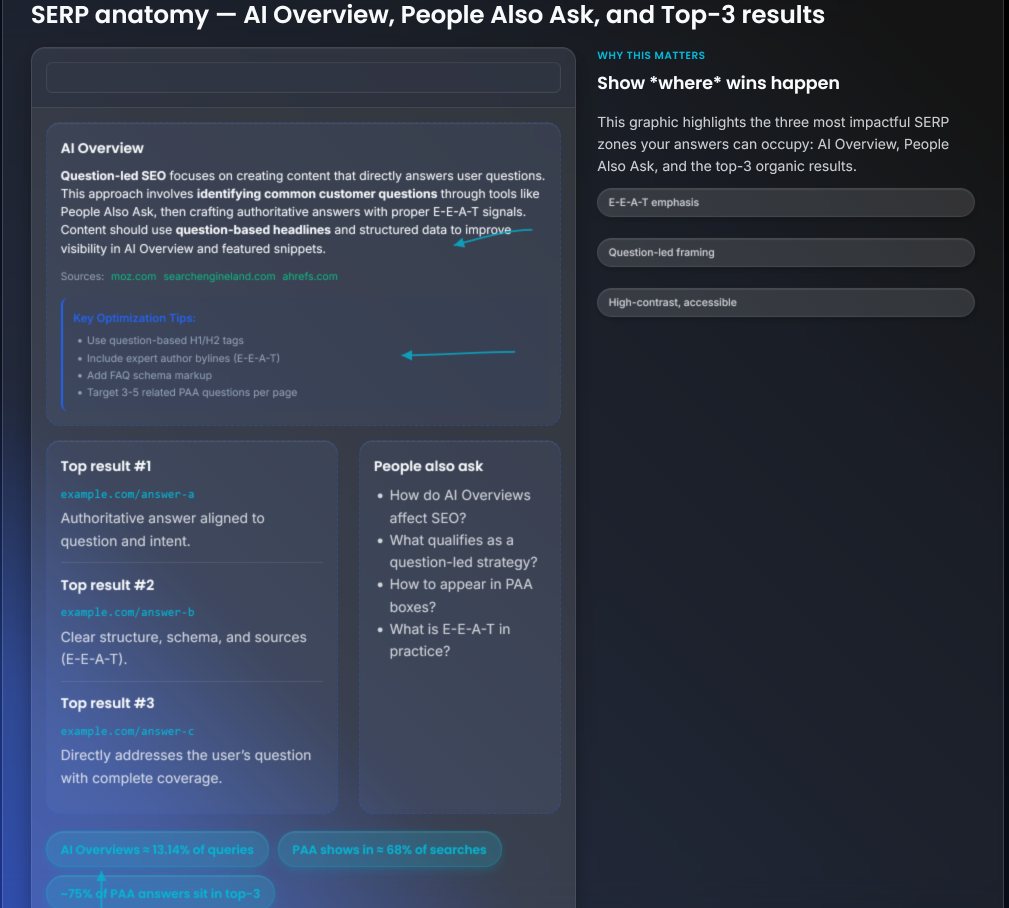
Google’s search experience has evolved dramatically. AI Overviews now appear in 13.14% of all queries, up from just 6.49% in January 2025. Meanwhile, 68% of English searches display People Also Ask (PAA) boxes, making these features impossible to ignore.
But here’s the crucial insight: 75% of People Also Ask results appear in the top three Google results. This means that businesses answering customer questions aren’t just getting visibility—they’re getting prime real estate in search results.
Why This Works in B2B
There’s a well-known effectiveness gap: most teams run content, but far fewer call it truly effective. Add the fact that ~95% of buyers are out of market at any given time, and the mandate is clear: your b2b content must guide future demand and move in-market buyers forward. Decision-makers complete 60–70% of their journey digitally, trust strong thinking over generic marketing, yet rate much of what they read as average. Answering real questions—well—closes that gap.
Beyond Traditional SEO: The Customer-Centric Approach
“We’re successfully intercepting competitor traffic by answering the questions our customers actually ask—it’s working better than traditional SEO,” explains Ilia Tretiakov, highlighting a strategic shift that’s delivering measurable results.
This approach works because it addresses search intent directly. Instead of optimizing for what you think people search for, you’re responding to what they actually want to know. The result? Companies successfully intercepting competitor search traffic see significant increases in qualified visitors.
From Volume to Value
High-performing teams prioritise quality over cadence and use data to steer topics, depth, and CTAs. In practice, that means fewer, better pieces that fully resolve the query. It’s the kind of b2b content Google’s AI systems elevate—and that buyers actually finish and act on.
Competitive Intelligence Advantage
Map the questions your competitors ignore or answer weakly. Build definitive responses that out-explain them. This is how you intercept competitor traffic and grow qualified visitors without chasing vanity keywords.
Smart businesses are using competitor traffic analysis to identify content gaps and opportunities. Understanding where competitors get their traffic helps reveal successful strategies and uncover new opportunities.
When you combine this intelligence with customer question research, you create a powerful competitive advantage.
The key is identifying the questions your competitors aren’t answering—or aren’t answering well. These represent opportunities to capture market share through superior, customer-focused content.
The AI Overview Opportunity
Google’s AI Overviews represent a massive opportunity for businesses willing to adapt. These AI-generated summaries pull information from multiple sources to provide comprehensive answers, and appearing in AI Overviews can significantly increase visibility for complex questions.
The companies succeeding in AI Overviews share common characteristics: they create authoritative, well-researched content that directly answers user questions. They focus on expertise, authoritativeness, and trustworthiness—exactly what Google’s AI systems prioritize.
Industry Applications: Real-World Success
In specialized industries like utilities and submetering, this approach is particularly powerful. The submetering billing software market is projected to reach $2.5 billion by 2033, growing at a CAGR of 9.1%, creating significant opportunities for companies that can establish thought leadership.
Property management companies using smart metering see 15-30% reductions in utility consumption, demonstrating the real value these solutions provide. When businesses create content addressing the questions property managers actually ask about submetering implementation, ROI measurement, and tenant billing, they capture qualified traffic from decision-makers ready to invest.
The Technical Implementation
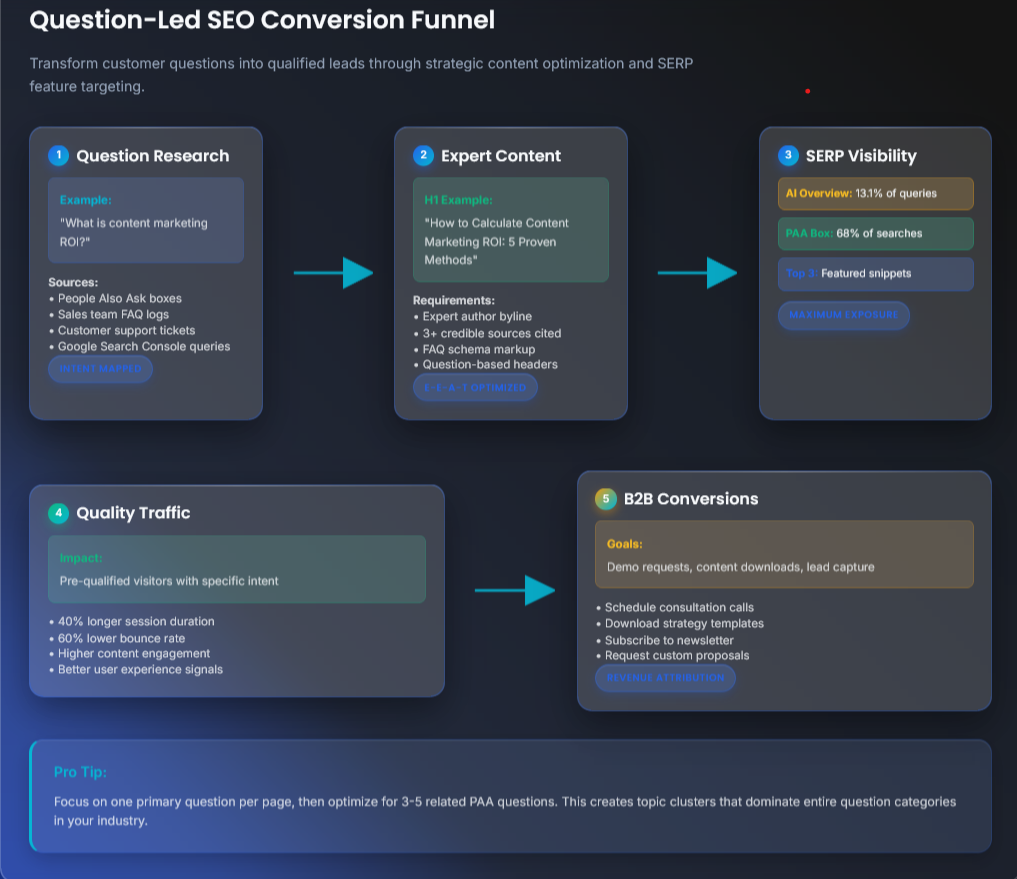
Successfully implementing a customer question strategy requires systematic research and execution:
Question Research: Use tools to identify People Also Ask queries related to your industry. 75% of PAA results appear in top three positions, making this research invaluable.
Content Creation: Develop comprehensive answers that address user intent completely. AI Overviews favor content that provides authoritative, detailed responses.
Competitive Analysis: Analyze competitor traffic sources to identify content gaps and opportunities for differentiation.
Measuring Success
- AI Overview appearances: Track when your content appears in AI-generated summaries
- People Also Ask features: Monitor PAA box appearances for your target questions
The Future of Search Strategy
As search continues evolving, the businesses that thrive will be those that truly understand their customers’ questions and provide exceptional answers. With AI Overviews expanding globally and People Also Ask boxes appearing in the majority of searches, this approach isn’t just strategic—it’s essential for long-term visibility.
The companies already implementing this strategy are seeing results: increased visibility, higher-quality traffic, and improved conversion rates. They’re not just optimizing for search engines—they’re optimizing for the humans using them.
Taking Action
The shift from keyword-focused to question-focused SEO represents more than a tactical change—it’s a fundamental realignment with how people actually search and what they want to find.
Start by identifying the questions your customers ask most frequently. Research what appears in People Also Ask boxes for your industry terms. Then create content that doesn’t just answer these questions but provides the most comprehensive, authoritative response available.
The businesses that master this approach won’t just survive the AI revolution in search—they’ll thrive in it.
Inventory real customer questions (PAA, sales calls, support tickets).
Prioritise by intent and revenue impact.
Publish the most complete, credible answer on the web.
Distribute intentionally.
Measure pipeline, not just clicks.
FAQ: B2B Content Marketing Effectiveness
Q: Why do most B2B content marketing efforts fail to deliver results?
A: The primary reason is misalignment between content production and decision-maker needs. While 97% of B2B marketers use content marketing, only 29% consider their efforts extremely effective because they focus on quantity over quality and fail to address specific industry challenges that decision-makers face.
Q: How can B2B marketers improve their content marketing ROI?
A: Focus on data-driven content strategies that target specific geographic markets and audience segments. Research shows that 88% of marketers witnessed increased conversion rates through data-driven tactics. Tailor messaging to distinct audiences—utilities prioritize reliability and integration, while property managers focus on cost savings and deployment ease.
Q: What makes B2B content trustworthy to decision-makers?
A: Authority and expertise are crucial. 73% of decision-makers say thought leadership content is more trustworthy than marketing materials, but only 15% rate the quality as very good or excellent. Create content that demonstrates deep industry knowledge, provides actionable insights, and addresses specific business challenges rather than generic industry trends.
Q: How should B2B marketers measure content marketing effectiveness?
A: Move beyond vanity metrics to track business outcomes. Focus on lead quality, conversion rates, and revenue attribution rather than just engagement metrics. The most successful B2B marketers track website traffic (71% do this), but also monitor time on page, conversion rates, and customer lifecycle progression to understand true content impact.
Q: What’s the optimal content distribution strategy for B2B marketers?
A: Use a multi-channel approach with social media platforms (90% effectiveness), blogs (79%), and email newsletters (73%). LinkedIn delivers the best value for 84% of B2B marketers. However, distribution success depends on tailoring content format and messaging to each platform while maintaining consistent quality and authority across all channels.