

When forces harmonize, there are compounding outcomes — outcomes that are impossible if these forces work independently.
In the same way, when sales and marketing act as collaborative forces pushing in the same direction, there are synergizing effects that can capture unrealized efficiency and revenue.
This is the impact of sales enablement content. SO GOOD ! This is the impact of sales enablement content. In the same way, when sales and marketing act as collaborative forces pushing in the same direction, there are synergizing Click on link →
It’s so simple, but this kind of sales-marketing alignment is notoriously overlooked.
Unified sales and marketing teams generate precise, targeted storytelling. Effective storytelling helps prospects imagine services and products as part of their story. Sparking that imagination closes deals.
Unsynced Messaging
Organizations rarely devote the proper time, energy, or capital to making sales-marketing collaboration work. What ends up happening is core messaging defaults to the whims of a C-suite professional.
For messaging to lock in and resonate with on-the-ground realities, however, there must be collaboration and trust between frontline sales and marketing teams.
“If the message is unclear to your teams, you can only imagine what your potential clients feel.”
Ilia Tretiakov, Chief Strategist at So Good Digital
If marketing teams don’t collaborate with sales teams about prospective and existing clients, they won’t understand your org’s ideal customer profiles (ICPs), the common pain points, and what clients see as high-value propositions.
If sales teams don’t listen to the primary marketing message and understand how leads are prospected, they’ll miss valuable pitch prompts and misfire on conversions.
This disjointedness boiled down to a lack of time investment into intentional collaboration and an unwillingness to take responsibility for the process.
The ultimate result of all this is an unclear message. And if the message is unclear to your teams, you can only imagine what your potential clients feel.
Sales Enablement Messaging Strategies
Your organization is busy functioning, so how can implement sales enablement shifts without disruption?
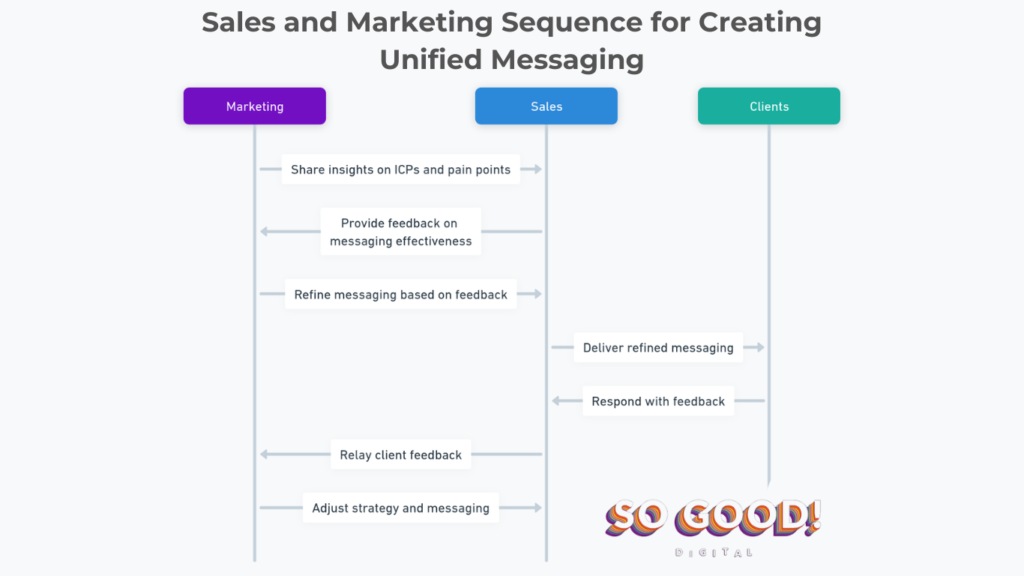
First, a leader in either sales or marketing should champion the cause. It’s rare that both teams are on the same page about this, and while it benefits both teams equally, marketing should lead.
“When I would play the role of chief marketing officer (CMO), I would always be the one to focus on sales enablement,” says Ilia Tretiakov, chief digital strategist with So Good Digital. “This is because demonstrating return on investment (ROI) in marketing is complex. When marketing is linked in through sales enablement, the impacts are much more clear.”
Unified messaging is a pillar of your organization’s sales enablement SO GOOD ! sales enablement When I would play the role of chief marketing officer (CMO), I would always be the one to focus on sales enablement Click on link → strategy.
Next Steps for Sales Enablement Messaging
-
- Plan to succeed: Delegate clear responsibility. Craft a solid meeting agenda. Begin the process of having a sales enablement meeting more than once.
-
- Don’t over-plan: Keep meetings as minimal as possible. Zoom in on creating short-term actions. Don’t wait until the plan is perfect, you’ll perfect the plan as you work it out.
-
- Clarify Targets: Marketing and sales should be looking for client patterns and trends. Sales need to both record paint points and distill them into segments. All of this should happen in a customer relationship management (CRM) where they can be easily tracked and shared.
“Tools like Seismic are great. While Seismic leans into sales, the insights found are tremendous for marketers,” Ilia says. “They even have a section on their website about inconsistent storytelling.
“The technology also has features for marketers, but I wouldn’t necessarily gravitate toward those. I would scrape as many sales insights as I could and then put it through our own strategy and planning process.”
“Sales enablement messaging concentrates your teams’ energies in the same direction, breaking the glass ceiling on sales and propelling lead generation.”
Ilia Tretiakov, Chief Strategist at So Good Digital
A clever marketing team should be able to find ways to record the most desired KPIs and data in your native CRM and avoid adding more tech to your operation stack.
Conclusion
Your sales and marketing teams are powerful forces. If those forces are moving in different directions, it is straining your organization. Sales enablement messaging concentrates your teams’ energies in the same direction, breaking the glass ceiling on sales and propelling lead generation.
So Good Digital’s marketing professionals help enterprises and scaling organizations pinpoint this kind of synergized messaging. We work with leaders to identify opportunities for sales collaboration and messaging and execute strategically.
Schedule a discovery call
SO GOOD !
Schedule a discovery call
So Good Digital’s marketing professionals help enterprises and scaling organizations pinpoint this kind of synergized messaging.
Click on link →
to take the first step!