

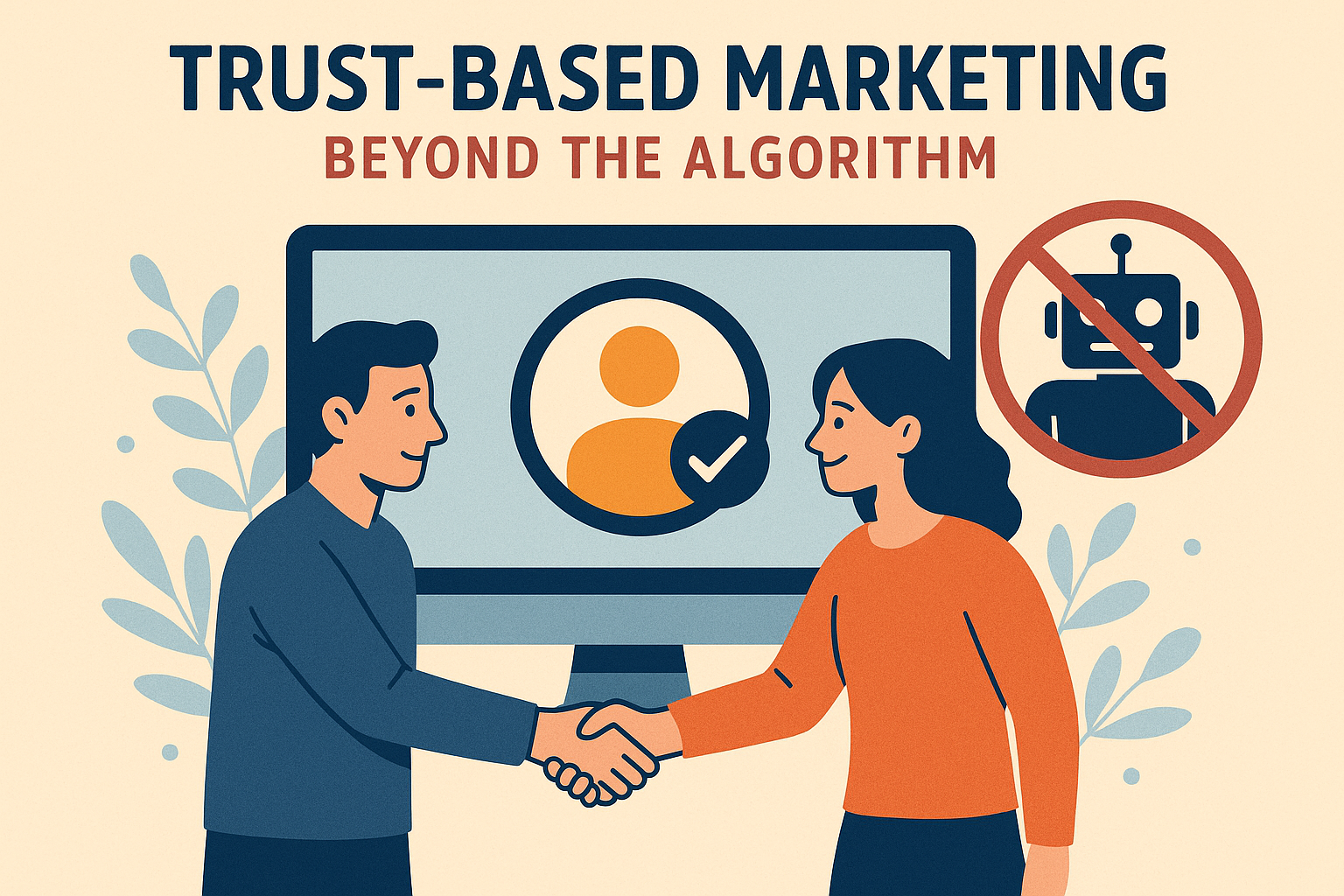
First off, a big thank you to Gilbert Schwartmann for featuring us in his excellent newsletter, Building Trust in B2B: The Most Crucial Performance Metric – In Practice (#100). You can check out Gilbert’s thoughtful breakdown and the shoutout he gave us on LinkedIn here.
Why Trust Still Matters More Than Anything
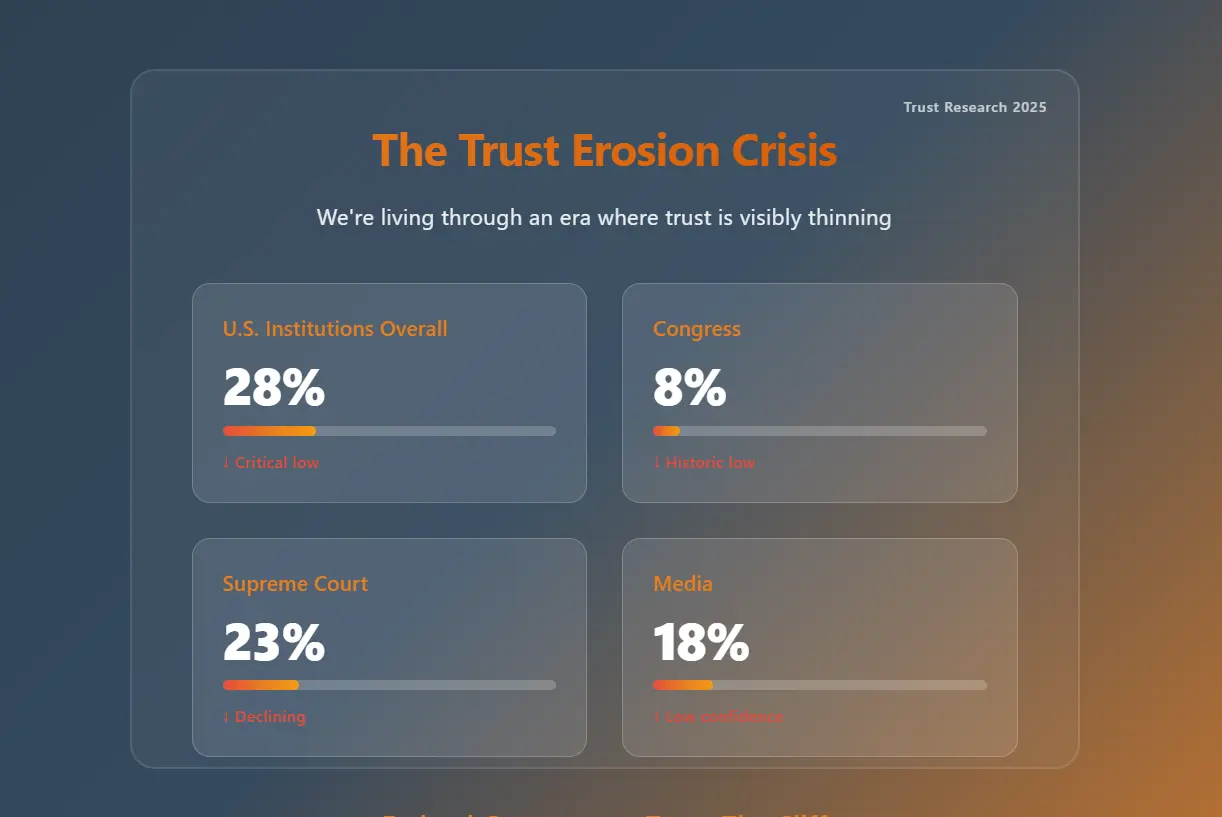
We’re living through an era where trust is visibly thinning. Confidence in U.S. institutions hit 28% in 2025 , with Congress languishing at 8%, the Supreme Court at 23%, and the media around 18%. Pew puts public trust in the federal government at 22%—down from 77% in 1964 . That’s not a dip; that’s a cliff. And when people stop trusting institutions, they don’t magically transfer that confidence to brands—especially not in B2B, where buying cycles are long, stakes are high, and the cost of being wrong is real.
At So Good Digital, we remind clients of this constantly:
“Trust isn’t something you say you have. It’s something you prove—over and over again.”
That proof becomes even more critical in today’s content environment. AI has supercharged output, which isn’t a bad thing on its own—we use these tools too. But when everything starts to sound algorithmically polished, audiences tune their scepticism to eleven. One unreviewed chatbot response or auto-generated reply can get screenshot, memed, and shared before lunch, taking your perceived truthfulness with it.
So the job isn’t to sound human; it’s to be trustworthy. Build human-in-the-loop reviews into your publishing process. Set clear escalation paths for anything sensitive. Default to clarity, receipts, and real outcomes—case studies, client quotes, frank post-mortems—so prospects see evidence, not claims. In a market where trust is scarce, being the brand that shows its work isn’t just smart positioning. It’s your competitive advantage in trust-based marketing.
The Real Elements of Trust (And Why Most Companies Get Them Wrong)
If you’ve ever worked in sales or customer experience, you’ve probably heard the classic trifecta: credibility, integrity, and benevolence. Sounds good in theory, right?
But here’s the truth—most companies over-index on the language of trust and under-deliver on the proof.
“Our customer experience is the best in the world!”
“We care deeply about our clients!”
“We believe in transparency!”
That’s great. But unless you’re showing it through actual client stories, transparent reporting, and evidence of outcomes, it’s just filler.
Instead, I encourage clients to show, not tell. Highlight the real wins. Share the testimonials that weren’t scripted. Talk about moments where things didn’t go perfectly—and how you fixed them.
Because nothing builds trust like benevolence in action.And nothing sustains it like trust-based selling that prioritises long-term relationships over quick conversions.
So, Can You Actually Measure Trust?
This is one of the hardest parts, especially for B2B teams who don’t always see immediate feedback loops. But yes—you can measure trust.
The simplest, most effective way? Net Promoter Score.
“If you’re not tracking your NPS or some version of customer satisfaction consistently, you’re not really investing in trust. You’re just hoping for it.”
We recommend starting small. Run one survey post-onboarding. Ask a few clients after a successful project. Make it part of your culture—not a one-off initiative.
Tools like Delighted, Hotjar, and even Google Forms can help. But the real value is in starting conversations that go beyond “Are you happy?” and into “How can we serve you better?”
How We Build Trust—Content and Strategy, Hand-in-Hand
At So Good Digital, we look at trust from two sides:
1. Strategic Trust
This means building systems where you’re actively seeking feedback from your clients. Not just when there’s a problem, but as a recurring touchpoint. You’re measuring sentiment. You’re asking what could be improved. And—importantly—you’re following up. And—importantly—you’re following up. It’s long-term, not reactive. Tie those loops back to
shared KPIs so teams stay aligned.
SO GOOD !
shared KPIs so teams stay aligned
This means building systems where you’re actively seeking feedback from your clients. Not just when there’s a …..
Click on link →
It’s long-term, not reactive.
2. Content-Level Trust
This is where your case studies, testimonial videos, and even your LinkedIn posts come in. Are you highlighting real client stories? Are you showing your team solving real challenges? Are you naming the tension your clients face before you swoop in with a solution? Do all touchpoints ladder up to a
unified message your sales team
SO GOOD !
Unified message your sales team
This is where your case studies, testimonial videos, and even your LinkedIn posts come in.
Click on link →
echoes in the field.
We help clients lean into this by embracing what I call radical transparency:
“Talking about your failures is a breath of fresh air—especially for executives. People don’t want to hear only your highlight reel.”
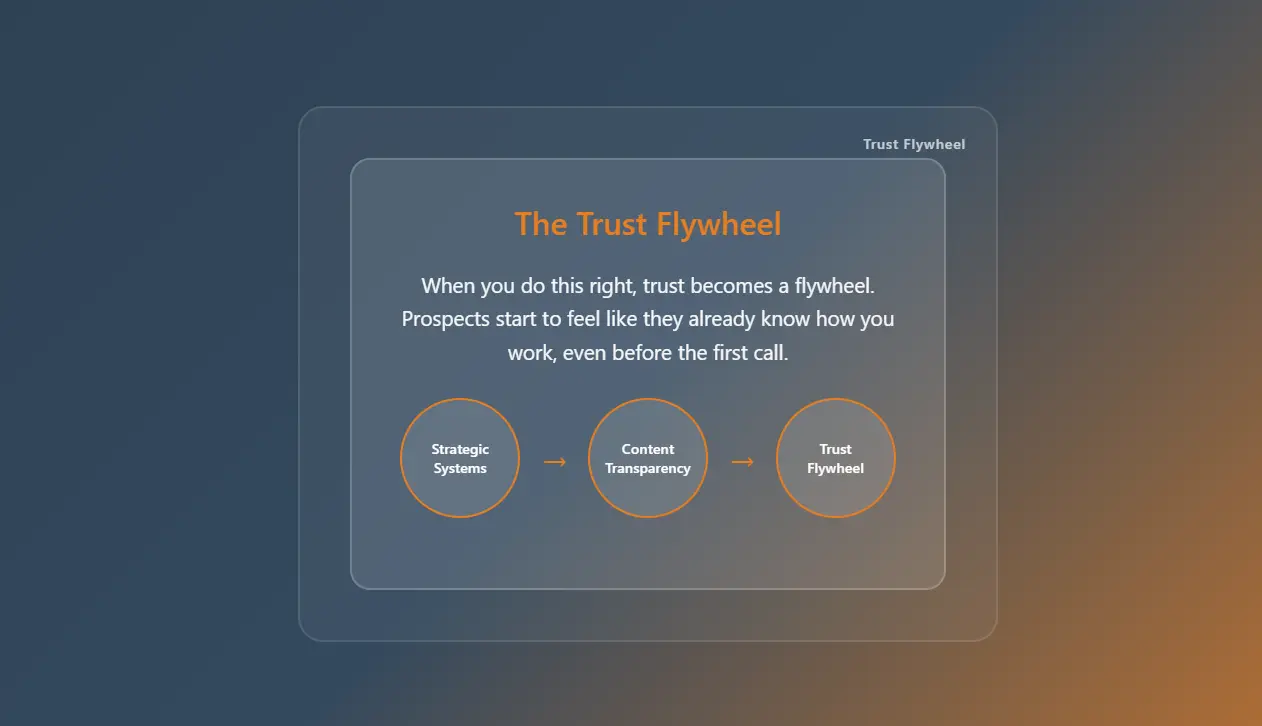
When you do this right, trust becomes a flywheel. Prospects start to feel like they already know how you work, even before the first call.
The Cultural Challenge (and Why Most Companies Don’t Do It)
Here’s the hard part. A lot of organizations say they want to build trust—but they’re not actually ready to open themselves up to that level of scrutiny.
They want to appear transparent without actually being vulnerable. But buyers are smart. They can smell it.
“If you’re trying to manufacture the perception of trust without the evidence to back it up, prospects will sniff it out—and choose someone more transparent.”
That’s especially true now, in the AI era. One bad chatbot response can go viral and wreck your brand’s perception (hello, Metrolinx). People aren’t just evaluating your product—they’re evaluating your truthfulness.
In Summary: The Real ROI of Trust Based Marketing
All the data backs it up—trusted brands retain more customers, get higher margins, and grow faster even in economic downturns. But that only happens if you’re doing the work:
Collect real feedback
Talk about your real wins and failures
Build content that reflects who you really are
And stay consistent in the long term
As I often say:
“Trust is the most important KPI you’re probably not tracking.”
Let’s change that.
FAQ: Trust-Based Marketing & Sales in 2025
What is the trust-based marketing theory?
It’s the idea that in a noisy, automated world, trust—not clicks—is the true currency. Trust-based marketing treats every interaction as a moment to earn credibility: through transparency, consistency, and actual proof. It’s not about seeming trustworthy—it’s about being trustworthy at scale.
What is an example of trust-based selling?
Imagine a sales rep who opens a call by disqualifying prospects that aren’t a good fit. Or one who shares a competitor’s tool when it’s genuinely better for the client. That’s trust-based selling: empathy over pressure, fit over funnel. It works—because it respects the buyer.
What are the 5 dimensions of trust in sales?
While frameworks vary, common dimensions include:
Competence – Can you do the job?
Reliability – Will you do it consistently?
Integrity – Are you honest, even when it’s inconvenient?
Benevolence – Are you acting in the client’s interest?
Transparency – Do you show how decisions are made?
Great trust digital marketing strategies reinforce these dimensions across every touchpoint.